THE EXCAVATION
In 1998, just outside the ancient city walls of Pisa, towards the sea, the Italian State Railways began excavation work alongside Pisa San Rossore railway station. Wooden objects immediately came to light, and archaeologists quickly recognised their exceptional significance. The Italian Ministry of Cultural Heritage and Activities and Tourism (MiBACT), in agreement with Rete Ferroviaria Italiana (RFI), promptly launched an archaeological investigation of the site.
At a depth of approximately three metres, an impressive collection of shipwrecks was uncovered. In 1999, RFI was therefore compelled to relocate the station building to another site. A major archaeological excavation project was subsequently launched, continuing until 2016. It brought to light around thirty Roman-era vessels, along with thousands of ceramic fragments, glass and metal objects, and artefacts made of organic materials.
Through the painstaking work of archaeologists and conservators, the pieces of a complex historical puzzle gradually came together, revealing a long history of trade and seafaring, voyages and maritime routes, everyday life on board and shipwrecks.
The exceptional state of preservation of the finds had a significant impact on the excavation process. Particular care was required to prevent the wooden structures from being excessively exposed to atmospheric conditions, while ensuring that all the necessary scientific documentation could be completed.
Having remained submerged in an oxygen-free environment, the wood had retained its anatomical structure. The absence of oxygen had prevented fungi and bacteria from proliferating and attacking cellulose and lignin, the fundamental components of plant cell walls.
A preliminary system for protecting the finds was devised on site using fibreglass panels. During excavation, the shipwrecks were carefully uncovered using standard archaeological excavation methods, with the protective panels progressively removed. The work proceeded in small sections, measuring between 50 centimetres and one metre, each of which was recorded three-dimensionally before being covered again with a moisture-retaining fabric.
To maintain the necessary humidity levels, a misting system was installed directly over the finds. Specifically designed for each vessel, it ensured that the wood remained adequately moist throughout the excavation process.
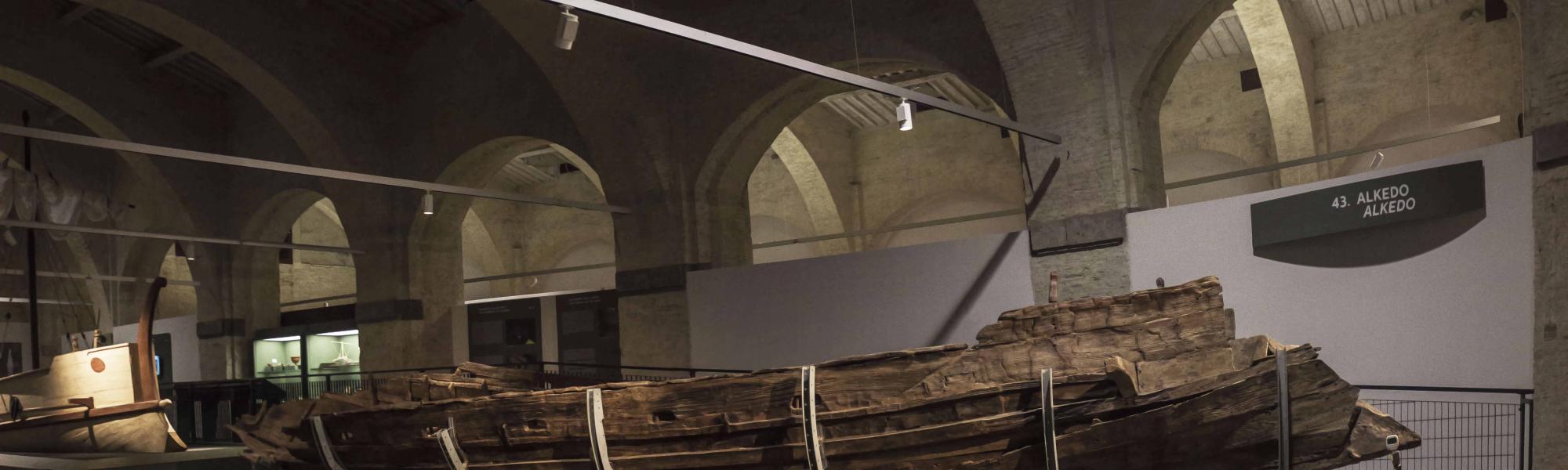
A new fibreglass shell was then fitted over each vessel to protect it during lifting, transportation and relocation. Once fully encapsulated, the vessel was secured to a metal frame, lifted and transferred to the conservation laboratory for restoration.
CONSERVATION AND RESTORATION
An experimental approach was adopted, with the specific challenges presented by each hull assessed and addressed individually.
The hulls that had survived almost intact were excavated gradually, in carefully controlled stages. Each section brought to light was enclosed in a perforated fibreglass shell, allowing conservation solutions to be introduced to ensure the temporary preservation of the wood. Fibreglass provided effective protection for the hulls during their transfer to the conservation laboratories following excavation.
The final conservation and presentation methods were determined by a number of factors, including the degree of deterioration of the wood—which could vary considerably even within the same wreck—and the overall state of preservation of each vessel (whether complete or partial, and whether its various components remained connected or had become detached).
The impregnation process involved the use of different consolidating substances, including PEG (polyethylene glycol), rosin and Kauramin®, among others. This was followed by controlled drying, either in carefully regulated environmental conditions or using freeze-drying technology.
Even the most fragmentary hulls, in some cases consisting of only a handful of elements, were carefully recovered using custom-made fibreglass shells. They were then placed in tanks containing water and a biocide in preparation for their final conservation treatment.
The archaeological excavation also yielded a large number of wooden objects, which had survived because they were completely waterlogged. The restoration process involved removing the water while ensuring that the wood did not shrink, crack or become distorted. The water was gradually replaced with substances that filled the microscopic cavities within the wood, allowing it to remain stable during the drying process, whether carried out in controlled environmental conditions or using a freeze-dryer.
The final surface treatment consists of a microcrystalline wax coating, applied both for aesthetic purposes and to help stabilise the wood against fluctuations in the humidity of the surrounding environment.
Museum of Ancient Ships

Arsenali Medicei, Lungarno Ranieri Simonelli 16 Pisa (PI)
+39 050 8057880

Amor amoris: un viaggio nell'ars amatoria alle Navi Antiche
10m
Museo delle Navi Antiche di Pisa
10-02-2024
18-02-2024