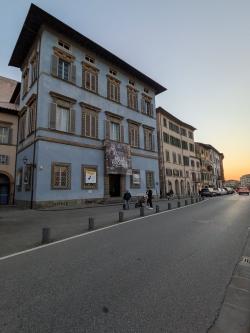
Edward Hopper, Beyond the Exhibition: Five Events at Palazzo Blu in Pisa Exploring History, Art, Film, Literature, and Architecture.
Open through March 7, 2027, the exhibition “Edward Hopper: New York and Beyond” traces the American artist’s career through the places that shaped his development and imagination: Paris, New York, and New England. Organized by the Whitney Museum of American Art in New York in collaboration with Fondazione Palazzo Blu and MondoMostre, with support from Fondazione Pisa, the exhibition is curated by Barbara Haskell, curator at the Whitney Museum of American Art, together with Caroline Webb, assistant curator at the museum. The exhibition brings together over 150 works—including paintings, drawings, watercolors, and etchings by Hopper and some of his most significant contemporaries—from the Whitney’s collections, along with a selection of archival materials related to the artist’s life and career.
Accompanying the exhibition is a series of five events that, from November 5, 2026, to February 11, 2027, offer a look at the artist and his era from different perspectives. History, consumer culture, painting, cinema, literature, and architecture are the key themes of the Public Program, which invites visitors to explore what lies behind Hopper’s images: the transformations of American society, the tensions of modernity, the relationship between spaces and people, and the silence and unease of everyday life.
The series opens on November 5 with a two-part event dedicated to the historical and social context of the United States. Arnaldo Testi, former professor of U.S. History at the University of Pisa, will address the topic “Conservative Individualism in the Era of the New Deal (and Edward Hopper).” The session will focus on the political convictions of the artist—a reserved yet staunch opponent of Roosevelt—and the persistence of an individualist and anti-statist culture during the years of federal government reforms. During the same event, Giulia Crisanti, a historian and professor at the American University of Rome and the University of Pisa, will speak on “Imaginary Realms and Consumption in U.S. Democracy at the Dawn of the American Century.” From Hopper’s experience as a commercial and advertising illustrator to the movie theaters, gas stations, and storefronts that populate his paintings, the talk explores the emergence of modern consumer society and the ambivalences accompanying its rise.
On November 19, art historian Stefano Zuffi will present “Hopper: Light and Solitude in the American Landscape.” From his formative years in Paris to the landscapes of 20th-century America, the talk traces the development of an original artistic language capable of capturing—through architecture, landscapes, and everyday gestures—the poetry of silence, the distances between people, and the small hopes of their lives. This journey also highlights the presence of his wife Jo, his lifelong companion and a central figure in the artist’s work.
The relationship between painting and cinema will take center stage on December 17, when film and literary critic Fabio Canessa will present "The Illuminated Windows". Hopper’s images evoke stills from stories in which the viewer can imagine a “before” and an “after”; at the same time, his compositions, lighting, and atmospheres have inspired generations of filmmakers. The event explores this creative exchange, in which the painted window and the movie screen become vantage points from which to observe the lives of others.
The program continues on January 14, 2027 with Cristina Iuli, professor of American Literature at the University of Eastern Piedmont, and the meeting What Light Doesn't Say. The Uncanny in Hopper's America. The artist's paintings will be put in dialogue with the pages of Sherwood Anderson, Ernest Hemingway, Cornell Woolrich, Shirley Jackson and Wallace Stevens. Illuminated rooms, deserted streets, and solitary figures become the starting point for recognizing a shared sensitivity, in which everyday life allows anxieties to surface and what remains unexpressed takes on a decisive weight.
Closing the series, on ’February 11, 2027, will be Lina Malfona, associate professor of Architectural and Urban Composition at the University of Pisa, with When the Sun Slices Through the Crystal Air’. The houses of Hopper. Through the homes and lives glimpsed within them, the intervention delves into the relationship between domestic space and the outside world, between light and silence, custom and restlessness: elements that make Hopper's homes places capable of conveying, even when inhabited, a profound loneliness.
The Public Program enriches “Edward Hopper: New York and Beyond”'s journey with opportunities for exploration that bring art, history, and culture into dialogue, broadening our perspective on the artist's work and the American context of the twentieth century. In line with the exhibition project promoted by Palazzo Blu together with the Whitney Museum of American Art and MondoMostre, the series of meetings contributes to enhancing the exhibition as an opportunity for cultural knowledge and discussion for the city and its audience.
All meetings will be held at 5:00 pm in the Auditorium of Palazzo Blu. Admission is free while seats last.
For info: https://palazzoblu.it/
"Edward Hopper" exhibition: https://www.turismo.pisa.it/en/eventi/Edward-Hopper-exhibition-at-Palazzo-Blu
