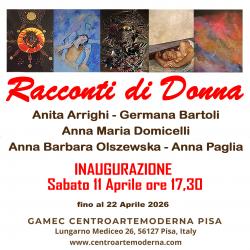
*EXTENDED UNTIL 6 MAY*
The GAMeC CentroArteModerna in Pisa, under the direction of Massimiliano Sbrana, presents "Racconti di Donne", a new and significant step in its commitment to promoting contemporary artistic research. The exhibition, hosted in the historic spaces overlooking the Lungarno Mediceo, will be open from Saturday 11th to Wednesday 22nd April 2026 and will open on Saturday 11th April at 5:30 pm, in the presence of the artists.
There is a thread that runs through Racconti di Donne, but it is not a single, linear or predictable thread: it is a dense weave, a complex plot made up of sensibilities, memories, techniques and visions that meet, touch and sometimes contradict each other, generating a lively and surprising dialogue. The group brings together five contemporary artists —Anita Arrighi, Germana Bartoli, Anna Maria Domicelli, Anna Barbara Olszewska, and Anna Paglia— who transform their experience into visual language, each with a distinct, recognizable, and necessary voice, and who together compose a mosaic of perspectives on the female world and, more generally, on the human experience. At a historical moment in which art continues to question the present and redefine the boundaries of imagination, this exhibition presents itself as an invitation to listen: not a passive listening, but an attentive listening, capable of welcoming the plurality of female paths that intertwine in the rooms of the GAMeC in Pisa. The works on display cross different territories — interiority, matter, memory, textiles, the human figure, cosmology — and yet, despite their heterogeneity, they share a common tension: the search for an authentic expression, capable of transcending the visible to reach what vibrates beneath the surface of things, what is often not said but perceived, that which belongs to the sphere of intuition rather than that of description. The title Racconti di Donne does not want to define a univocal female identity — it would be impossible, as well as reductive — but celebrate the multiplicity of experiences that these artists embody. Every work is a fragment of life, a gesture that becomes a narrative, an image that becomes a voice, a piece of a larger story that does not claim to be exhaustive, but which opens, expands, multiplies. The exhibition does not propose a manifesto, it does not seek to impose a reading, but offers a space of resonance in which each visitor can find their own point of contact, an emotion, a memory, a question.
The five protagonists bring very different universes to the exhibition. Anita Arrighi works with textiles as if it were an extension of memory: every thread, every plot, every color becomes a story, a gesture, a memory. His long technical and teaching experience translates into works that are not simply “made”, but constructed with a care that is both artisanal and poetic. In his works we perceive time: the time of gesture, the time of learning, the time of transformation. Its textile surfaces seem to hold stories that are not said out loud, but are slowly revealed, like whispered confidences. Germana Bartoli, with her academic training and years dedicated to art history, explores silence as a place of the soul. Her female figures seem suspended in an inner time, far from the noise of the world, immersed in a dimension that is not escape but concentration, not isolation but depth. The sign becomes voice, the color becomes breath, and that silence reveals itself as a territory of listening and introspection. His works do not cry out: they wait. They invite you to slow down, to pause, to let yourself be crossed by a stillness that is not immobility, but emotional density.
Anna Maria Domicelli showcases the power of experimentation. For her, every material is a possibility: fabrics, mortars, semi-precious stones, processing waste, pigments. Nothing is excluded, nothing is considered “minor”. Its practice is an ongoing laboratory, a territory where creative urgency translates into ever-new forms, capable of combining elegance and freedom. His works seem to arise from a constant dialogue with matter, a dialogue in which the unexpected is not an obstacle, but a resource, an opportunity to discover new directions. His search is never satisfied: it is a movement, a process, a crossing. The sensitivity of Anna Barbara Olszewska, haute couture designer and painter, is of a completely different nature. In his portraits there is no trace of the glamour that characterizes the world of fashion: instead, a subtle melancholy emerges, an introspective delicacy that envelops the faces and bodies depicted. His hand, confident and refined, restores to the human figure an emotional depth that recalls Expressionism, but filtered through a personal and intimate sensitivity. His characters seem to inhabit a fragile elsewhere, made up of restrained emotions and unforgotten glances, as if every face were the threshold of a story that remains partly secret.
Finally, Anna Paglia looks up to the sky. Its constellations, its galaxies, its multiverses are not simple astronomical representations: they are visions, internal maps, attempts to shape infinity. His canvases seem suspended between levity and density, between science and poetry, between order and chaos. To look at them is to have the feeling that the universe, for a moment, is approaching, or that we are approaching it. His works do not describe: they evoke. They do not explain: they suggest. They are open windows to an elsewhere that is not distant, but deeply connected to our interiority.
Hosting this plurality of views is the GAMeC CentroArteModerna in Pisa, one of the longest-running and most vital galleries (almost an institution in Pisa) in the city. Founded in 1976, the GAMeC in Pisa has spanned nearly fifty years of Italian art history, maintaining a vibrant programming and ongoing dialogue with artists, critics, and collectors. Under the direction of Massimiliano Sbrana, the GAMeC in Pisa continues to be a place of encounter and exchange, a crossroads of generations and languages, overlooking the Lungarno Mediceo as a window onto contemporaneity. The exhibition is part of this tradition, renewing and expanding it, offering a space where female creativity is not celebrated as a category, but recognized in its complexity and richness.
Visiting Women's Stories means connecting with five creative universes, each with its own light. It means being guided by images that speak of life, of dreams, of silences, of matter, of stars. It means, above all, listening to the stories these women have chosen to share through art — stories that don't end with the visit, but continue to resonate, as do stories that truly touch, those that don't try to convince, but to accompany, those that don't impose a truth, but open up a space of possibilities. At a time when everything seems to be demanding speed, this exhibition invites a simple and revolutionary gesture: stop, look, listen.
Free entry.
Opening Hours: from Tuesday to Saturday 10.00-12.30 and 16.00-18.30;
Special opening Sunday, April 12, 2026, 4-6:30 PM.