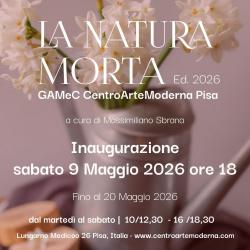
The GAMeC CentroArteModerna in Pisa, directed by Massimiliano Sbrana, presents La Natura Morta: ieri e oggi, a new stage in its journey dedicated to promoting contemporary artistic research. The exhibition, set up in the historic spaces overlooking the Lungarno Mediceo (at number 26), in collaboration with the "Archivio d'Arte" collection, will be open to visitors from Saturday 9th to Wednesday 20th May 2026.
The exhibition acquires a new force when read through contemporary sensibility: still life is no longer just a genre, but a critical device that questions our relationship with time, objects, consumption, and memory. In an age dominated by speed, planned obsolescence and overproduction of images, it becomes a necessary counterpoint, an invitation to slow down and restore value to what usually goes unnoticed. In its apparent stillness, still life speaks of what is alive and changing: fruits, flowers, utensils and fragments of everyday life become mirrors of our time. As Norman Bryson recalled, “still life does not simply represent objects: it thinks them”, and it is precisely this ability to think about objects that makes it so relevant today. In contemporary society, objects are no longer simple material presences, but symbols, memories, residues, desires. Still life isolates and suspends them, removing them from the flow of consumption and returning them to the gaze. The exhibition thus becomes a laboratory of perceptions, a place to question our relationship with things, with time, with fragility. Jean Baudrillard recalled that “objects are never just objects: they are systems of meaning”, and the artists on display demonstrate this by transforming objects into metaphors for precariousness, memory, the ecological crisis, and the visual saturation of the digital. In a world where everything flows and everything wears out, still life becomes a form of resistance. Susan Sontag described photography as a way to “stop time and make it visible”: still life makes a similar gesture, suspending the rhythm and inviting contemplation, restoring dignity to attention and slowness. Contemporary artists reinterpret this gesture through painting, photography, assemblage, organic or industrial materials, and digital techniques, with a shared desire to make things speak, to free them from indifference. The theme is also intertwined with the environmental crisis: many artists use still life to reflect on the fragility of ecosystems and the tension between artifice and life. Rachel Carson remembered that “nothing exists alone”: even a cut fruit or flower tells a larger story, which concerns our relationship with the planet.
The exhibition thus becomes not only a tribute to tradition, but an invitation to look with new eyes at what surrounds us, to recognize the beauty and vulnerability of things. Still life has always been a meditation on time, transience, and transformation. Paul Valéry wrote that “to see is to forget the name of what one sees”: gender invites precisely this, to go beyond the surface to grasp the essence. Today objects become witnesses to our personal and collective memory, habits and desires. The exhibition stages this dialogue between past and present, between permanence and change, between what remains and what disappears.
Here are the artists present at this edition: Stefano Ballantini, Franco Banti, Alberto Berti, Luciano Borin, Michele Bracciotti, Daniele Carta, Eugenio Contatore, Mimmo Dorrado, Marco Dolfi, Paolo Fidanzi, Sergio Frascari, Francesca Giorgetti, Stefania Hepeisen, Claude Lafoy, Carlo Lapucci, Italo Lotti, Claudio Magrassi, Michela Marinai, Alberto Martini, Guido Morelli, Maria Teresa Pannunzio, Silvia Pierucci Sapio, Diva Severin, Vincenzo Tortorella, Giuseppe Viviani, Alessandro Volpi.
Free entry.
Opening Hours: Tuesday to Saturday 10 am - 12:30 pm/4 pm - 6:30 pm; Special opening Sunday, May 10, 2026, 4 pm - 6:30 pm.
Inauguration: Saturday, May 9, 2026, 6 PM
Info: https://www.centroartemoderna.com/