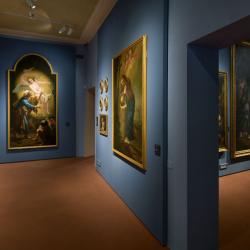
On Sunday 25 May 2025, the National Day of the Italian Historical Houses Association returns, now in its 15th edition: over 450 exclusive places such as castles, fortresses, villas, parks and gardens will be open for free, in an immersion in history that still makes our country identifiable in the world and that could be the pivot of long-term sustainable development.
In Pisa open the following places:
- PALAZZO BLU (Lungarno Gambacorti 9). The permanent collection of Palazzo Blu will be visited free of charge.
At 3:30 p.m. will be held in the Auditorium a conference on the painter Nicola Torricini, curated by Stefano Renzoni and Federico Tognoni, followed by a visit to the rooms of the palace decorated by the artist. The conference is part of the thematic route on Nicola Torricini promoted by ADSI between Villa Amalia in Borgo a Buggiano (PT), Villa di Corliano in Corliano (PI) and Palazzo Blu in Pisa city.
Opening hours: 10 a.m. - 8 p.m.
Free admission, without reservation for the visit to the permanent collection.
Compulsory reservation at the form for the Conference on the painter Nicola Torricini.
The following visit to the halls will take place in groups of up to 20 people -> https://www.associazionedimorestoricheitaliane.it/evento-dimora/442869/?tab=toscana&prov=pisa&lan=it
- GIARDINO GARZELLA (Via Sant'Antonio 106). The garden will be open for free, to welcome visitors will be present the owners, who will provide some brief historical notes on the garden.
Free entry, without reservation.
Opening hours: 10 a.m. to 1 p.m / 2:30 p.m. to 6 p.m.
The Garzella palace and garden are located in an area previously occupied by the Patriarch’s House, as witnessed by a nineteenth-century print that represents a compact two-storey building with high roof, accessible from Via Sant'Antonio and accompanied by a large garden.
Owned by Garzella since the early twentieth century, the building was destroyed in the tragic bombing that hit the neighborhood of Sant'Antonio on August 31, 1943. It was rebuilt by the engineer Giovanni Battista Garzella in the fifties, who reversed the layout of the complex, with the front of today’s building overlooking via Francesco Crispi and the large garden that winds around the back, in a raised position from the road surface.
The plan of the garden develops through a fluid system of stone paths that identify a calligraphic design of grassland areas substantiated by a lively volumetric play of shrubs, of the trees - selected according to an eclectic taste - and vast floral punctuations that contribute to the liveliness of this reserved space.