*EXTENDED UNTIL APRIL19, 2026*
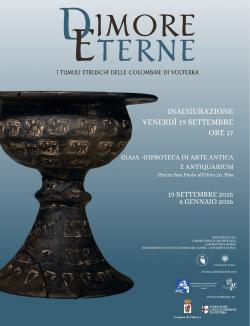
The archaeological exhibition “Eternal Abodes. The Etruscan Mounds of the Colombaie of Volterra” (19 September 2025 – 6 January 2026) returns in a new exhibition format, set in the evocative location of the Plaster Cast Gallery of Ancient Art and the Antiquarium of Pisa.
Beginning on Friday, 19 September at 5:00 PM, the exhibition will open to the public at the Plaster Cast Gallery of Ancient Art, featuring a new installation curated by the Laboratory of Archaeology and the Marsyas Laboratory of the Department of Civilizations and Forms of Knowledge, in collaboration with the Superintendency of Archaeology, Fine Arts and Landscape of Pisa and Livorno, and GiArA – the Plaster Cast Gallery of Ancient Art and Antiquarium of the University.
The exploration of the Etruscan necropolis—where an archaeological investigation has been underway since 2016, conducted by the Etruscology team of the Department of Civilizations and Forms of Knowledge of the University and coordinated by Dr. Lisa Rosselli—has led to the discovery of several chamber tombs constructed in stone and covered by mound structures. The excavation is carried out under a ministerial concession to the Municipality of Volterra and is conducted in collaboration with SABAP Pisa and Livorno, with the support of the Cassa di Risparmio di Volterra Foundation.
The research originally began with the aim of rediscovering the traces of an isolated chamber tomb identified in the 1920s and later forgotten. However, over the past few years, the significance of the investigated area has progressively increased as excavation work has revealed the existence of an extensive necropolis, currently consisting of three large funerary mound structures dating back to the Late Orientalizing period of the Etruscan era (that is, the period spanning the late second half of the 7th century and the early decades of the 6th century BCE).
This discovery represents an absolute novelty for Volterra, where, until now, the type of chamber tomb surmounted by a circular stone mound had not been documented. In contrast, several examples from the same period are known in the surrounding area, particularly between the Cecina Valley and the Elsa Valley.
Adding to the importance of this finding, in 2020 one of the mounds identified during the excavation was found to be intact, with its entrance still sealed by large stone slabs, and the contents of the burials and grave goods undisturbed. This exceptional discovery provides valuable insights into the funerary customs and practices of the community that inhabited Volterra during a remote period in its history.
Opening of the Exhibition "Eternal Abodes. The Etruscan Mounds of the Colombaie of Volterra"
Friday, 19 September 2025, at 5:00 PM
To enhance the value of the newly discovered Colombaie necropolis and to promote public awareness of it, the archaeological finds recovered from within the funerary chamber of Tumulus 2, together with the inhumation and cremation burials, will be displayed inside the Plaster Cast Gallery of Ancient Art and Antiquarium. The exhibition will be accompanied by reconstructions of the ceremonies and rituals associated with the burials, while video projections will offer visitors a virtual journey into the necropolis and inside the tumulus tombs, providing essential context for the items on display in the cases.
Furthermore, to offer a broader overview of the scope of the archaeological site, a second exhibition area within the Gallery will feature ceramic materials related to a domestic structure built on the Colombaie plateau a few decades prior to the construction of the tumuli (in the late 8th to early 7th century BCE) and later obliterated when the site was repurposed as a funerary area with large monumental tombs.
The exhibition is completed by several inhumation tombs from the Late Imperial Roman period (3rd–4th century CE), which testify to a reoccupation of the area many centuries after the Etruscan tumuli had been abandoned. These tombs likely belonged to a segment of the Volterran community that chose this site, rich in historical memory, as a burial place for some of its members.
INFO:
https://www.gipsoteca.sma.unipi.it/
Plaster Cast Gallery of Ancient Art and the Antiquarium of Pisa
Piazza San Paolo all’Orto, 20 – Pisa