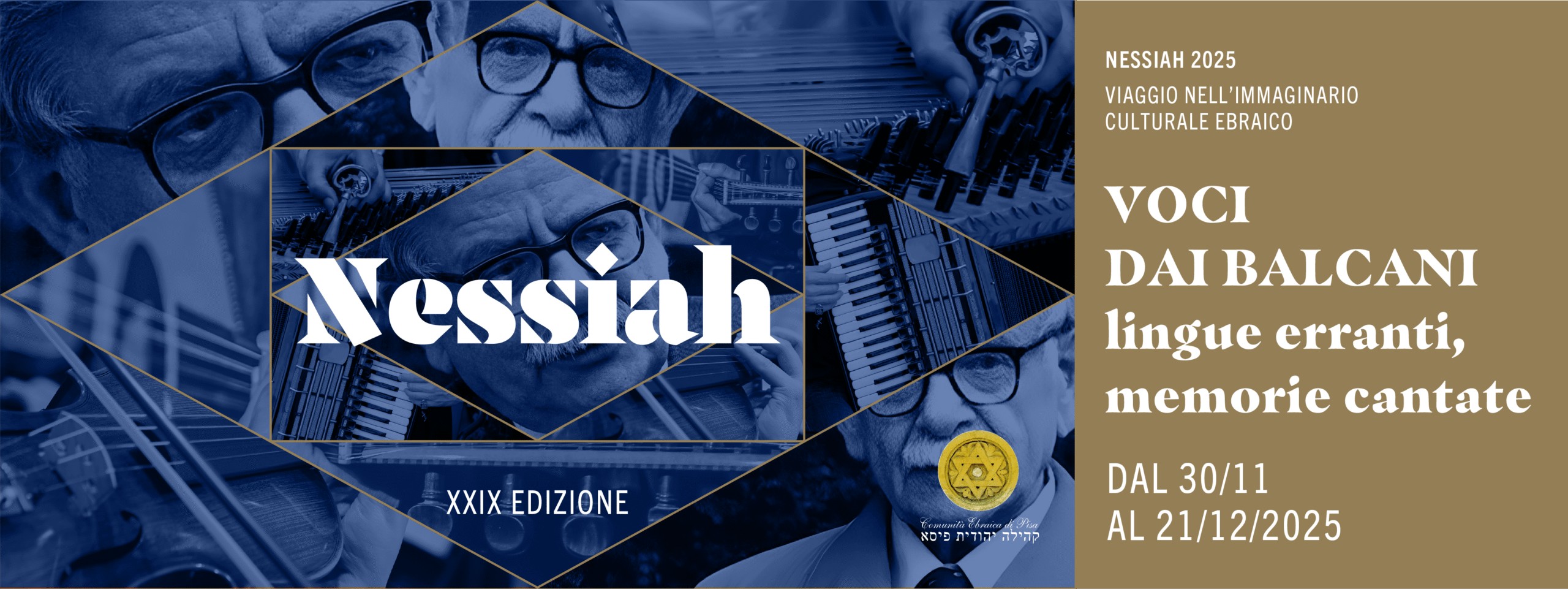
“Nessiah” in Hebrew means journey. Not just physical displacement, but inner journey, search for meaning, crossing places, stories, identities. It is from this vision that, for nearly thirty years, the Nessiah Festival has proposed a cultural itinerary in Tuscany that traverses the many forms of contemporary Jewish expression: music, theater, speech, art, and memory.
For the 2025 edition, Nessiah looks to the East, to the territories historically crossed by the Jewish diaspora after their expulsion from Spain, and chooses the Balkans as its central theme, a millennia-old crossroads of languages, cultures, and religions. A region marked by an intense and often torn history, but also a place where Jewish traditions, particularly Sephardic ones, have found space to take root, flourish, and transform.
Between Thessaloniki and Sarajevo, Ruse and Istanbul, Jewish communities have been able to keep their identities alive by intertwining them with surrounding cultures. Music, language, cuisine, rituals, and expressive forms have taken on hybrid traits, capable of telling stories of exile but also of resistance, fusion, and survival. These stories still speak to us today, in an age that questions borders, belonging, and the very meaning of “culture”.
The 2025 edition of Nessiah offers a multi-stage itinerary where shows, concerts, meetings and installations build a shared narrative around three main axes:
- Sephardic memory in the Balkans: explored through Judeo-Spanish music, liturgical chants, oral testimonies, and post-1492 diaspora traditions;
- The thought of Elias Canetti: Nobel Prize winner for literature, born in the Jewish community of Ruse, Bulgaria, a symbol of Central European linguistic and cultural complexity;
- The Jewish Mediterranean as a space for dialogue: to be read not only as a geographical space, but as a symbolic place of coexistence, contamination, and encounters.
COMPLETE PROGRAM:
https://www.festivalnessiah.it/edizione-2025/
Officina dei Transiti, curator of the festival, offers a program that unites established artists and new generations, valorizing hybrid languages and interdisciplinary forms. All with a careful look at participation, inclusion and the dissemination of knowledge, according to the spirit that has always animated Nessiah.
In a time that tends to simplify and separate, Nessiah 2025 instead invites us to investigate complexity, to build bridges between different memories, to make Jewish culture a laboratory of civil and creative dialogue.