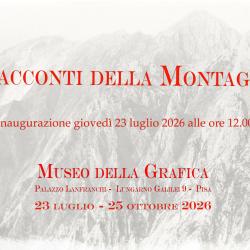
From Thursday, July 23, 2026, the Museo della Grafica will host the exhibition Mountain Tales, which will be on display until October 25, 2026.
Exhibition opening with free admission on Thursday, July 23, 2026, at 12:00 PM
The mountain tells many stories.
Between science and art, philosophy and literature, each story reveals landscapes of the soul, gives motifs that touch the spirit, reason, feeling.
The mountain is geology and paleontology, it is the history of the earth and of man, they are fossils and rocks but also drawings, engravings, paintings, sculptures, photographs and videos that form a splendid stratigraphy of memories, emotions, affections.
Enchanted and splendid landscapes “cathedrals of the earth”, according to the metaphor with which John Ruskin defined the Alps as “great cathedrals of the earth with their gates of rock, floors of clouds, choirs of streams and stones, altars of snow, and vaults of purple crossed by a scattering of stars” (Modern Painters, IV, 1856).
A metaphor adaptable to every mountain. Because the mountain is also and above all an idea, a category of the spirit, an aesthetic value and a moral imperative.
E’ an ancestor to love.
The exhibition Mountain Tales presents three of the most beautiful and evocative stories: Mount San Giorgio, the Apuan Alps, and the Pisan Mountains.
Overlooking Lake Lugano, Monte San Giorgio not only preserves an extraordinary heritage of Triassic fossils, but also preserves within the forest a rich stratigraphy of water, caves, altars and paths capable of intertwining the time of the earth with that of the sky.
The Apuan Alps and the Pisan Mountains represent the deepest structural relief in the Apennine chain and are characterised by particular types of rocks. The white Apuan marbles, metamorphosed Jurassic carbonate rocks, create a landscape unique in the world, as is the famous verrucan of the Pisan Mountains.
They are mountains that tell, like ancient storytellers, of rocks and fossils, of dragons and plants, of peaks and caves with the most surprising shapes, but also of hermits and healers, monks and travelers, scientists and artists.
Blessed Manfedi Settala, a 12th-century Milanese hermit and healer, chose Monte San Giorgio as a place of prayer and transcendence. At the foot of the Pisan Mountains, the Certosa di Calci shines with its message of “blessed solitude, alone beatitude”. Along the paths of the Apuan Alps, the “margine” thrill like purer and more solemn images of devotion.
Science writes extraordinary pages through the great Pisan geological school, which goes from Paolo Savi to Marco Tongiorgi. Their maps of the Pisan Mountains remain essential documents of two centuries of excellence in land history studies, also harking back to the illustrious cartographic tradition of Medici and Lorraine Tuscany.
Finally, it is the artists who manage to interpret and represent the complex sentimental variables of the most beloved mountains.
The sacredness of Monte San Giorgio is reflected in the photographs of Heinz Plenge and the engravings of Francine Mury, just as the shots of Giuseppe Viner and the Alinari convey the sense of the profound spirituality transmitted by the Apuan landscapes at the beginning of the 20th century. And the Apuan Alps themselves are sources of multiple suggestions, as evidenced by the photographs of Barbara Agostini, Stefano Baroni and Laura Veschi, the graphics of Giuseppe Biagi and Tano Pisano, the tempera paintings of Emilio Cavani, the marbles of Luciano Massari.