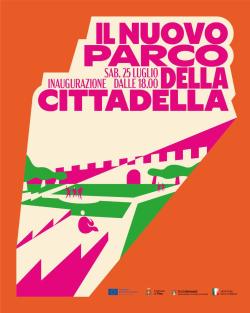
On Saturday, July 25th, the Municipality of Pisa will inaugurate the new Citadel Park. The central heart of the inauguration evening will be the Arena area, a charming and large central amphitheater where the stage will be set up, where some of the evening's important events will take place. Other spaces in the Park will host events and activities dedicated to the whole family.
From 5.00 pm to 9.00 pm, it will be possible to visit the Guelph Tower and the Fortress, while the inaugural ceremony, ribbon-cutting ceremony, and institutional interventions are scheduled for 6.00 pm. Following this, a small aperitif for the participants.
On the occasion of the inauguration, the Tourist Office of the Municipality of Pisa organized, as part of the tour “RiscopriAmo Pisa”, two extraordinary guided tours (starting at 6:30 pm and 9:00 pm) curated by Antonella Cinini and Alessandra Aleppo, entitled “The Galilean Citadel and Michelucci's Urban Dream".
Walks are reserved for residents of the Municipality of Pisa or, in the case of free places, in the municipalities belonging to the Terre di Pisa area.
At the moment, the places are sold out and it is possible to register on waiting lists. All the information on the site: https://tuscanyaround.it/pisa/.
In addition, from 5.00 pm to 9 pm , it will also be possible to visit the Guelph Tower and the Fortress (free admission).
The celebration for the inauguration of the Cittadella Urban Park will begin at 6.00 pm with the Inaugural Ceremony, the ribbon-cutting ceremony by Pisa Mayor Michele Conti, and institutional interventions. Following this is a small buffet for those present (Restaurant area).
Then, entertainment and baby dance for children (6.30 pm - 8.00 pm Playground area).
From 6.30 pm, a guided tour of the Park will be led by architect Fabio Daole, with the participation of members of the professional associations, the LP Architecture Biennale, the San Zeno Senior Citizens' Center, and the parish of San Nicola.
At 7.00 pm, a performance by the Musicians and Flag-Wavers of Pisa; while at 7.30 pm, a performance “Pyramid” by ASD Danza con Me (Area behind the Arena).
Starting at 8.00 pm (Restaurant area), the program includes a tasting “Not just Sangiovese. The blends of the lands of Pisa”, edited by FISAR Historical Delegation of Pisa.
An experienced sommelier, starting with a brief overview of wines produced in the province of Pisa, will guide the public through tastings of those made with a blend of grape varieties featuring Sangiovese, without being the sole creator of the product (subject to availability).
At 9.00 pm (Arena Area) the concert “Sounds from the Eighteenth Century” by the Tuscan Youth Orchestra. At the end of the day, starting at 10.00 pm, a musical show with vocalists, singers and dancers will take place for a musical show entitled “Timeless”, which will transport spectators on an engaging musical journey through time, bringing the audience back to life the energy of the years ‘70-‘80-‘90 and 2000.
All events and activities are free to enter.
Brief historical notes
July 25th will be an opportunity for citizens and tourists to learn about and understand the greatness of the Pisan Republic in its heyday. The area of the ancient Pisan dock, in the medieval Tersana area, developed during the 13th century as a shipbuilding area, at a time when military victories and flourishing maritime traffic had made it necessary for the city to find a space adequate for the intensity of naval activities. The defeats of the following century and the stalemate in commercial traffic caused the area to be reconverted as early as the end of the fourteenth century when Iacopo d'Appiano transformed the structure into a fortress, building the tower of Sant'Agnese, strengthening a pre-existing one and creating the first brick battlements.
The Tersana, completed over time with the Ghibelline, San Giorgio and Arno (or Degazia a Mare) towers, was definitively consecrated as a fortress starting in 1406. At that point it was the Florentines who made notable modifications: they reinforced the wall parallel to the Arno and equipped the Palazzetto above the pre-existing Porta della Degazia a Mare with ravelins. They also built the Guelph Tower (or Citadel Tower) from scratch: an 18m high building, today faithfully rebuilt after the bombings of 1944. The name Guelph was given to it in contrast to the Ghibelline tower.
The name Cittadella Vecchia came into use only later, to distinguish it from the Cittadella Nuova, the current Scotto Garden, built in the opposite corner of the city starting in 1440 and which is why the Cittadella Vecchia was used again as an arsenal from the second half of the 15th century onwards.
Later, in the 18th and 19th centuries the rooms of the Citadel were used as warehouses, stables and finally military barracks.
At the beginning of the twentieth century the area was called Piazza d'Armi and housed the buildings of the 7th Artillery Regiment, 22nd Infantry Regiment divisions and a small theatre. In 1944 the entire area was severely hit by Allied bombing: the buildings of the Citadel were damaged. The entire area of the citadel, once freed from the rubble, was the subject of a recovery project by Giovanni Michelucci called “Galilean Park”.