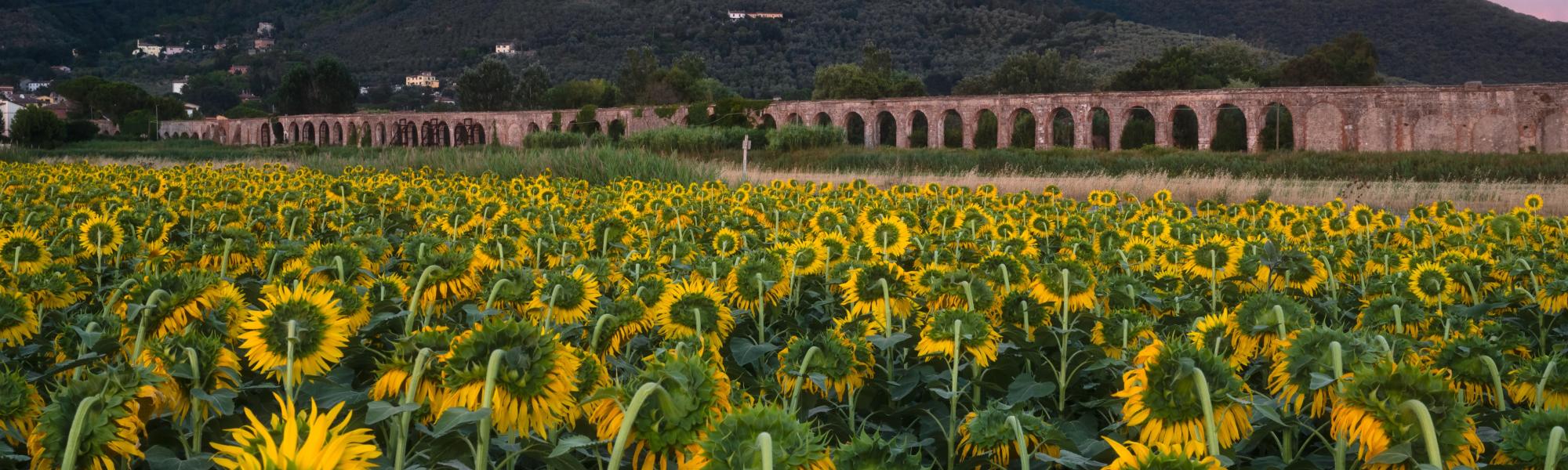
The Medici Aqueduct
From the sixteenth century onwards, the Medici embarked on a programme to revive Pisa, which they had chosen as their winter residence and the second capital of the Grand Duchy of Tuscany. Economically, they encouraged trade and forged closer links with the port of Livorno, whose merchants could supply Pisa’s markets with goods from across the Mediterranean and the New World. The Medici government also launched an ambitious programme of urban renewal, promoted new cultural initiatives and gave fresh impetus to the academic life of the University of Pisa.
Efforts to improve living conditions included the reclamation of the surrounding countryside and the regulation of the water supply. It was within this wider programme of improvement that the ambitious, and costly, hydraulic project of the Asciano Aqueducts was conceived.
Following the abandonment of the Roman aqueduct of Caldaccoli, Pisa met its growing demand for water by drawing supplies from the River Arno and, more commonly, from wells. This water was often unhealthy and could lead to illness and physical deterioration, as well as contributing to the spread of epidemics.
To address these problems, Cosimo I de’ Medici was the first to initiate the construction of an underground conduit designed to collect spring water from the Valle delle Fonti at Asciano Pisano and carry it towards the city centre. The project failed to meet expectations and was eventually abandoned because of serious structural problems.
In 1588, Grand Duke Ferdinando I, the son of Cosimo I, resumed the project, opting instead for a raised aqueduct supported by a series of arches, inspired by the great aqueducts of ancient Rome.
Until 1593, the design and construction of the foundations were overseen by the architect Raffaello Zanobi di Pagno. The work was subsequently continued by the engineer Andrea Sandrini and completed in 1613.
This remarkable structure of brick and stone, comprising more than 900 arches, begins at the Bottino di San Rocco at Asciano Pisano and follows a remarkably straight course for around 6 kilometres, before reaching Pisa at the Porto delle Gondole.
THE MEDICI FOUNTAINS
Following the ambitious programme of urban and architectural renewal begun under Cosimo I, the public fountains celebrated the Grand Dukes as the rulers who had restored Pisa’s fortunes and provided the city with a public water supply.
The coats of arms and symbols used as decorative features served as clear reminders of Medici power.
THE WATER SUPPLY NETWORK
The first water-distribution network consisted of two separate conduits branching off from the bottino dei Cavalieri, located outside the city walls.
The raised aqueduct carried water into the city along its series of arches, reaching the city walls at the so-called Porto delle Gondole and supplying Via Santa Marta and part of the Lungarno di Tramontana. The Order of the Knights of St Stephen was provided with an exclusive water supply through a separate conduit known as the “Religious Order” conduit.
Initially, the principal connections were located in Piazza San Francesco, Piazza d’Ancona, Piazza Santa Caterina and near the Archbishop’s Palace. Over the years, however, demand for connections increased, with an ever-growing number of private households and monasteries seeking access to the network.
THE PUTTI FOUNTAIN
The celebrated Piazza del Duomo required a public fountain to meet the needs of local residents and the many travellers arriving at the city’s most important monumental complex. Seventeenth-century documents held by the Office of Rivers and Ditches (Ufficio dei Fiumi e Fossi) record an earlier fountain known as the Fontana alle Gradole. It stood on the lawn, although in a different position from the present-day Fontana dei Putti.
Created by the master craftsman Marco Rondinosi in 1658, the original seventeenth-century fountain was probably a relatively simple structure of brick, with two mascheroni from which water flowed. It was dismantled and replaced by the Fontana dei Putti sometime after 1763.
The fountain that survives today occupies a prominent position overlooking the monumental complex. Made of white marble, it incorporates a seventeenth-century base attributed to Giuseppe Vaccà. Classical in style and enriched with mythological decoration, it is surmounted by three winged putti supporting the coat of arms of the Opera del Duomo, designed by Giovan Battista Tempesti.
THE ARCHBISHOP'S PALACE FOUNTAIN
The square-based fountain, richly moulded and decorated at the corners, is surmounted by a statue of Moses by Andrea Vaccà, dated 1709. Water flowed from two mascheroni into two corresponding basins, one shell-shaped and the other rectangular.
THE PIAZZA TONGIORGI FOUNTAIN
This small eighteenth-century fountain stands in a little square beside the Church of San Giuseppe. Made of white San Giuliano marble, it consists of a pedestal supporting a truncated pyramidal block from which the water emerges. An elongated, shallow basin at the base completes the structure.
THE PIAZZA MARTIRI DELLA LIBERTÀ FOUNTAIN
The water-supply network served the Church and Convent of Santa Caterina, the Monastery of Sant’Anna—which in 1668 incorporated the Convent of San Girolamo dei Gesuati, also equipped with a fountain—and, above all, the monastery attached to the Church of San Lorenzo alla Rivolta.
The historian Alessandro Da Morrona described the fountain at San Lorenzo in the following terms: “This square [...] remained poor in houses and devoid of ornament until these days, when at last it has benefited from the good taste of the age with the addition of a magnificent fountain. Fully conceived in the manner of a sacred altar, set into the ordinary, rough wall of a garden and inappropriately clad in Carrara marble, it stands as a reminder to all who pass of its former, dishonoured dignity” .
The original fountain was destroyed along with the monastery. In its place stands a Neoclassical fountain designed by Alessandro Gherardesca. It consists of a truncated column of white marble, decorated with fluting and festoon motifs, resting on a base from which the water basin projects.
THE PIAZZA D'ANCONA FOUNTAIN
Supplied by the Condotta della Religione, this simple fountain consists of a column in pietra serena from Gonfolina, with white-marble details, surmounted by a sandstone finial decorated with carved ornament.
The fountain stands at the centre of Piazza d’Ancona, near Palazzo Ruschi. The square was once known as the second Piazza San Francesco, adjoining the church of the same name.
THE VIA SAN FRANCESCO FOUNTAIN
The first institution to request a connection to the Office of Rivers and Ditches was the Convent of San Francesco, in 1627. The only surviving evidence of this original installation is a badly preserved carved panel bearing a lion’s head from which the water once flowed.
Set into the corner of the house adjoining the church, the original fountain was probably a relatively simple structure. It was later moved at the request of the friars, who wished to secure a water supply for their garden. In the mid-eighteenth century, at the request of the municipal authorities, it was replaced and relocated to the centre of Piazza San Francesco to meet the growing demand for public water.
THE PIAZZA DELLE GONDOLE FOUNTAIN
This is the first urban fountain supplied by the Medici Aqueduct. Originally attached to the wall of the Santa Marta cistern—a large piscina limaria used for the settling and purification of water, now demolished—it was later relocated against the city walls near the Porto delle Gondole.
The fountain takes the form of a classical marble aedicule, made entirely of white San Giuliano marble. Its upper niche is shaped as a shell and surmounted by a broken pediment bearing the Medici coat of arms. The upper mask depicts a young man.
The fountain probably served as a continuous-flow water source. Water first collected in the vessel set on the projecting shelf before falling into the drain below, creating a gentle play of water. The lower mask provided water for the needs of the local population.
THE PIAZZA SAN LUCA FOUNTAIN
This fountain dates from the eighteenth century and stands near the former Church of San Luca, dating from the eleventh or twelfth century. The church was partially demolished during the sixteenth century and suppressed in 1783.
The fountain rests on a pietra serena base and has a notably simple design. It consists of a column faced with white marble and a basin for collecting water, topped by a flattened pyramidal finial.
THE VIA SAN MARTINO FOUNTAIN
This Neoclassical marble fountain was designed by the engineer Bombicci in the early nineteenth century. It consists of an imposing fluted column set on an octagonal base and surrounded by sixteen small columns of the same material.
THE LOGGE DI BANCHI FOUNTAIN
The first seventeenth-century conduit forming part of the water-distribution network serving the Lungarno di Mezzogiorno was completed around 1619, with the completion of the underground section running from Piazza de’ Cavoli beneath Ponte Vecchio, now Ponte di Mezzo.
The Logge dei Banchi were built between 1603 and 1605 to a design by Buontalenti and executed by Pugliani. Their construction was prompted by the need for a covered market where the wool and silk guilds could conduct their business. At the centre of the eastern elevation is the Medici coat of arms, dated 1605.
Beneath it, attached to the wall, are the remains of a small fountain with a shallow basin, now disused. The outline of its rim, creating a bat-wing effect, echoes the central decoration depicting the head of the nocturnal creature. The basin is supported by a bracket decorated with another grotesque head and a worm-like motif.
THE PIAZZA CAIROLI FOUNTAIN (Formerly Piazza della Berlina)
The fountain assumed its present position at the centre of the square in 1822, when the area underwent improvements and urgent underground works were carried out to restore the hydraulic infrastructure. Originally set against the Church of San Pierino in Vinculis, the fountain had caused frequent flooding as a result of deteriorating pipes.
The original lion-shaped mascheroni were salvaged and incorporated into the later white-marble fountain. The statue of Abundance, standing on a column with an Ionic capital, was created by Pierino da Vinci, nephew of the celebrated Leonardo, in 1550.
The female figure holds a cornucopia in her left hand and fruit in her right, symbolically reflecting the role of the square: on the one hand, as a city market; and on the other, as a celebration of the prosperity Pisa regained under Medici rule.
THE PIAZZA DELLE VETTOVAGLIE FOUNTAIN
From the fifteenth century onwards, the square was known as Piazza del Grano or Piazza dei Porci, reflecting its role as a city market. It acquired the name Piazza delle Vettovaglie only in 1771, under the rule of the House of Lorraine.
Its present appearance is the result of numerous alterations and rebuilding campaigns carried out over several centuries, while its commercial function has remained unchanged.
The fountain on the southern side of the square dates from 1715. Made of white marble, it bears three coats of arms: the Medici arms; a divided shield bearing the emblems of the Republic of Pisa and the Opera del Duomo; and the arms of the prominent Pisan Caietani family.
THE PIAZZA DEI CAVALIERI FOUNTAIN
The marble fountain known as the Fontana del Gobbo was erected by the Flemish sculptor Pietro Francavilla in 1596 to a design by Giambologna. Set at the foot of the statue of Cosimo I de’ Medici, it takes its name from the hunched human figure gazing towards a shell-shaped basin supported by a sea monster with human legs, fish fins and a crab’s head.
The statue depicts the Grand Duke wearing ceremonial armour and holding a staff of command. He gazes into the distance, with his left foot resting on a dolphin. Before becoming a structural element, the dolphin was intended to serve as the fountain’s water spout, as recorded in the commission document of 1594.
The pairing of statue and fountain clearly celebrated the efforts to secure a reliable water supply for the city of Pisa—an achievement ultimately made possible by the aqueduct commissioned by Ferdinando I, which was nearing completion by 1596.
THE GIARDINO DEI SEMPLICI FOUNTAIN
From Piazza dei Cavalieri, the conduit continued towards Palazzo dello Stellino in Via Santa Maria, carrying away the water discharged from the fountain of Cosimo I. Here stood a simple small fountain designed by the architect Raffaello di Zanobi di Pagno towards the end of the sixteenth century.
The conduit continued as far as the Giardino dei Semplici, corresponding to the present-day Orto Botanico. The first botanical garden, regarded as the oldest university botanical garden in Europe, was established in Pisa at the request of Cosimo I as early as 1543, as part of his efforts to revive the University.
Initially located in the area of the Arsenal, it was moved in 1563 to the vicinity of the convent of Santa Marta, before being transferred to its permanent location near Via Santa Maria by Ferdinando I.
Texts edited by: F. Origlia e M. Colombini Piedi in Cammino APS - Fonti bibliografiche Chiare, fresche et dolci acque. C'era una volta l'Acquedotto Mediceo … e le fontane di Pisa / a cura di M.G. Letizia, C. Quercioli – Pisa: Biblioteca Comunale 2007 Il Principe, la città, l'acqua. L'Acquedotto Mediceo di Pisa / M. Gasperini, G. Greco, M. Noferi, S. Taglialagamba - Pisa: Edizioni ETS 2015