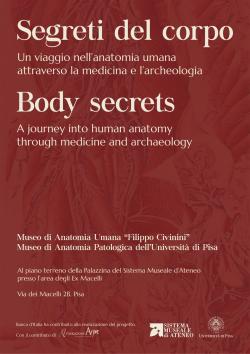
THE EXHIBITION WILL BE CLOSED FROM 6 TO 28 AUGUST 2026 (INCLUSIVE).
The exhibition "Secrets of the Body: A Journey through Human Anatomy via Medicine and Archaeology" offers a journey of discovery into the human body, exploring its morphological and pathological aspects from a historical perspective through archaeological finds.
Organised by the Museum of Pathological Anatomy and Palaeopathology and the Museum of Human Anatomy, the exhibition is on display at the University Museum Complex building at Via dei Macelli 2B / Largo Padre Renzo Spadoni – Pisa.
For information on admission fees and updates on the exhibition’s opening and closing dates: https://www.map.sma.unipi.it/segreti-del-corpo-un-viaggio-nellanatomia-umana-attraverso-la-medicina-e-larcheologia/.
The exhibition includes the following themes:
1. Historical development of the study of the human body through the centuries.
In addition to the reproduction of some anatomical plates by Paolo Mascagni, a work from the early 19th century that represents the human body in life-size, there are dry and wet anatomical preparations, and models that introduce human anatomy with a brief narration on the development of the discipline. Visitors are guided to discover the secrets of the human body, highlighting the role that the city of Pisa played in revolutionising knowledge of anatomy thanks to the construction of the Anatomical Theatre, commissioned by Cosimo I dei Medici, in which Vesalio taught the practice of dissecting corpses in 1544.
2. Description of various mummification techniques through archaeological finds.
Another fundamental aspect concerns the topic of the preservation of the body after death, which has accompanied human history for millennia. A number of mummies are exhibited, including a pre-Columbian natural mummy, a modern mummy obtained through intra-arterial embalming, and the natural mummy of a child who died of sepsis in the pre-antibiotic era. Accompanying this section are other important archaeological finds, namely the pre-Columbian collection brought from South America by the Pisan Carlo Regnoli, a surgeon and archaeology enthusiast, which also includes grave goods with anthropomorphic vases and some mummified Chilean heads.
3. Displays of internal organs and bone specimens, both healthy and affected by various diseases, including archaeological finds from various epochs.
Examples of anatomical preparations, both normal and pathological, are exhibited to illustrate the development of human anatomy over time, up to the most recent advances. The exhibits include foetal skeletons of different ages, preparations illustrating the vascular system, ancient archaeological and forensic bone specimens with pathological evidence, such as tuberculosis, osteochondroma, traumatic cleft lesions and a skull with drill, the oldest surgical operation performed by man. Other preparations include pathological organs in alcohol, including a lung with anthracosis, a pathology that makes the organ resemble that of a heavy smoker.
The exhibition activity is complemented by the organisation of events related to the themes of the exhibition and the offer of educational courses for schools of all levels on the themes of anatomy and archaeology.
For further information, please consult the museums' websites: