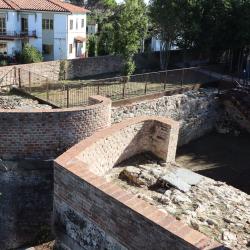
On the morning of Thursday, October 29, the Santa Marta Cistern and the Barbagianni Bastion were officially inaugurated. These two historic sites, located along the eastern section of the Pisa City Walls, underwent restoration and functional rehabilitation funded through the National Recovery and Resilience Plan (PNRR).
The two projects, part of a single initiative, made it possible to restore the ancient aqueduct reservoir—now transformed into an exhibition space dedicated to the history of water and its relationship with the city—and to reopen the spaces of the Barbagianni Bastion, a 16th-century defensive structure located near the San Silvestro complex. The connection via the walkway along the city walls allows both sites to be included in a tour route that combines historical heritage, culture, and the environment.
Inside the Santa Marta Cistern, informational panels and multimedia displays have been installed for the new Water Documentation Center.
THE SANTA MARTA CISTERNA
Located atop the medieval walls, near Piazza delle Gondole, the Santa Marta Cisterna is a structure built approximately between 1924 and 1925, connected to the Filettole aqueduct system. The structure consists of an exterior masonry shell with a gabled roof supported by wooden trusses, enclosing two reinforced concrete tanks originally intended for the collection and distribution of water.
The project involved the restoration and consolidation of the building, the rehabilitation of the roof and masonry, the creation of connections between the two tanks, the construction of new interior pathways, and the installation of the technical systems necessary for its new use. Structural consolidation and seismic retrofitting were also carried out, preserving and highlighting certain elements of the original hydraulic system, including the cast-iron pipes.
The former reservoir now houses a Water Documentation Center, dedicated to the history of the relationship between Pisa and water resources. The exhibition, which is particularly well-suited for school groups, uses informational panels, audiovisual content, and multimedia technologies to trace the evolution of the water system in the Pisa area, from historic aqueducts to modern infrastructure. Special attention is given to the first room, which features an immersive installation where projections on the walls and floor recreate the presence and movement of water inside the cistern, guiding visitors through a visual and auditory experience. The space also provides information on water consumption and usage in Italy and around the world, complementing the historical reconstruction with a reflection on the importance of water as a resource. The other spaces are dedicated to documenting and exploring the water landscapes and hydraulic works that have shaped the history of the city and the surrounding area.
The building’s location holds particular historical significance: the Medici aqueduct from Asciano, completed in the early 17th century under Ferdinando I de’ Medici, ended right near Piazza delle Gondole. An earlier cistern was located in this area, used for collecting and settling the water intended for the city’s distribution system. The new Documentation Center thus revives the memory of a place that, through different eras and infrastructure, has maintained a close connection with Pisa’s water supply.
THE BARBAGIANNI BASTION
The Barbagianni Bastion is a military structure built in the mid-16th century, leaning against the pre-existing medieval walls near the San Silvestro complex. Spanning three levels, the Bastion underwent a restoration project that included the restoration of the masonry, the refurbishment of the interior pathways, the enhancement of archaeological finds, and the preservation of the natural vegetation that had grown there over the years.
The works allowed us to recover and connect the upper level, at the height of the Wall walkway, with the intermediate one. New stairs and pedestrian paths were built, gravel pavements were repaired, and guardrails and protective elements were installed.
During the work, archaeological investigations were carried out which allowed us to identify and document previously invisible structures. The finds include a brick arch, which can be interpreted as access to an underground environment, additional wall structures and portions of the ancient floor plan of the Wall walkway. Some elements were left exposed, while others were protected and covered to ensure their preservation.
VISITING MODALITY
The Cistern of Santa Marta and the Barbagianni Bastion can be visited along the Walls of Pisa. Access to both spaces is included in the Pisa Walls ticket, at no additional cost, and follows the same opening hours as the walkway at high altitude, except for the closure which occurs one hour before the closure of the Walls.
From November to February, the route is open daily from 10.00 am to 5.00 pm, with the last entrance at 4.30 pm. In March, it opens from 10:00 am to 6:00 pm (last admission at 5:30 pm); from April to August from 10:00 am to 8:00 pm (last admission at 7:30 pm); in September from 10:00 am to 7:00 pm (last admission at 6:30 pm); and in October from 10:00 am to 6:00 pm (last admission at 5:30 pm).
