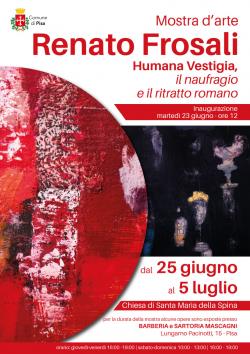
The Church of Santa Maria della Spina hosts canvases and sculptural compositions by Renato Frosali dedicated to dialogue with the classical world. The exhibition ideally recalls a room found in Pompeii, between a gallery of Roman portraits and a series of objects characterised by sophisticated colours. The works describe a research that departs from archaeological painting in the strict sense, with a figuration that arises from an inner elaboration and translates into images and suggestions capable of accompanying the visitor on an emotional journey through time. In the canvases, the reference to the Roman world is intertwined with a progressive reduction in perspective depth, which leads the representation towards a more evocative and spiritual dimension. Frosali's paintings and sculptures offer a personal key to understanding and imagination, eschewing simple description to confront the themes of memory, the erasure and permanence of human traces. The sculptures in fact recall figures that seem to re-emerge from archaeological excavations, such as ancient vestiges brought to light by time or re-emerged from water, in a continuous dialogue between conservation and transformation.
The exhibition, open until July 5th, will be open on Thursdays and Fridays from 4:00 PM to 7:00 PM, while on Saturdays and Sundays it will be open from 10:00 AM to 1:00 PM and from 4:00 PM to 7:00 PM.
The works exhibited in the Church of the Spina are also connected to the two canvases housed at the Barberia and Sartoria Mascagni (Lungarno Pacinotti, 15), characterised by a more figurative and descriptive language, giving rise to a path articulated in different places and constructed through a continuous play of references.
Born in Pomarance in 1962, Renato Frosali trained in Volterra, exhibiting throughout his life in solo and group exhibitions, both in Italy and in the rest of Europe. Fundamental to his poetics is the theme of dialogue with the ancient world, not understood as an iconographic repertoire to be reproduced, but as traces of a universal human experience. Faces, archaeological fragments, artifacts, and vestiges of the past become opportunities to reflect on time, the fragility of memory, and the permanence of images in collective consciousness.